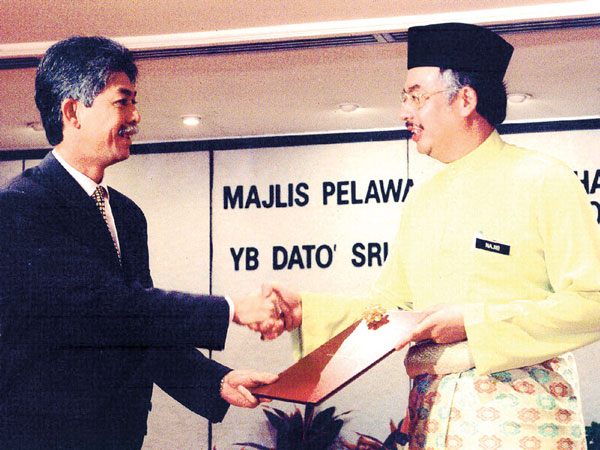
 The first day of Ramadan in 1997 fell on 10 January, and to many Malaysians this would be the only significance of the date. For a small group of people at the national oil corporation, PETRONAS, however, it was a day that will forever be etched in their minds for it was on this day that the Malaysian Government formally invited PETRONAS to establish Universiti Teknologi PETRONAS (UTP).
The simple ceremony, held in the podium block of Dayabumi Complex in Kuala Lumpur, marked the official commencement of the national oil corporation’s journey into the field of higher education.
The university’s achievements in the years since that morning in January 1997 have been nothing short of extraordinary – the most apparent expression of the university’s accomplishments is its physical appearance, in particular the stunning academic building, the Chancellor Complex, which received the prestigious Aga Khan Award for Architecture in 2007. But a university is not recognised for physical attributes alone, a fact its founders and proponents realised early on when crafting the university’s vision – to be a leader in technology education and a centre for creativity and innovation.
Although the university was formally established in 1997, UTP’s founding stretches a few years prior to that – to the early 1990s. This was the time of rapid industrialisation in Malaysia, and the Sixth Malaysia Plan (1992–1996) continued to emphasise the development of human resources to support the country’s ambitious industrialisation programmes. It was recognised and understood that the participation of the private sector was instrumental in producing skilled and professional workers that would meet industry’s requirements.
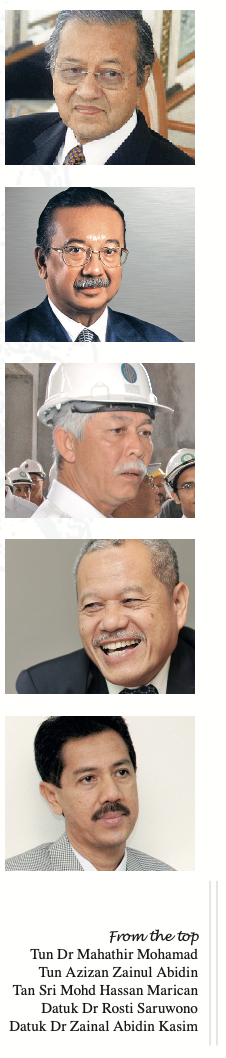 Former Prime Minister Tun Dr Mahathir Mohamad says that although the government initially felt that higher education should remain the realm of the public sector, it became apparent that the government could not cope with producing the required skilled personnel for the expanding economy. “So because of that the government decided that private universities should be allowed.”
Dr Mahathir, who was Chancellor of UTP from 2004 to 2016, points out that at the time PETRONAS was also expanding and the need for engineers, especially those qualified for the oil and gas industry, was growing. “The government felt that it would be good for PETRONAS to start a university and train its future employees,” he says.
The national oil corporation responded positively. Its board led by Chairman Tun Azizan Zainul Abidin and President and CEO Tan Sri Mohd Hassan Marican provided the direction, and gave the green light for the plans and resources invested.
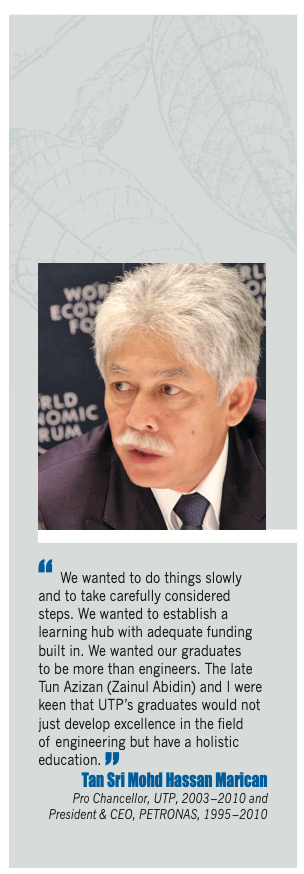 Hassan says education has always been one of PETRONAS’s core concerns. “We did not call it CSR (Corporate Social Responsibility) back then,” he says. “For us it was more than that. It was the cornerstone of nation building. We invested substantial amounts in education. We believed back then that we had to build human capacity and give people an opportunity and a chance to improve themselves. We did not want to give money for money’s sake. Instead, we saw education as a long lasting investment. After all, an educated person would have greater opportunity to contribute to the nation.”
Several board members were also actively involved during the early implementation stage including Tan Sri Mohamed Noordin Hassan. He had a unique background when it came to the university’s establishment having been Secretary- General to the Ministry of Education prior to his appointment as PETRONAS Vice President of Group Human Resource.
It was Mohamed Noordin, then still at the Ministry of Education, who relayed the news to PETRONAS and the other two Government linked companies (GLCs), Tenaga Nasional Bhd and Telekom Bhd of the government’s wish that they start their own universities. He was, prior to his retirement in 1994, responsible for the drafting of the Private Higher Educational Institutions Act.
A year after joining PETRONAS, Mohamed Noordin was tasked with leading a team within PETRONAS to explore the setting up of a university. Other key figures include Ir Mohamed Zohari Shaharun, then PETRONAS Vice President for Technology Resource Management who was brought in to handle the technical issues and Dr Mohamed Ariffin Aton, the then CEO of PETRONAS Research and Scientific Services Sdn Bhd (PRSS) who advised on academic matters and requirements of professional bodies.
Although the government was encouraging the setting up of private institutions of higher learning, the law did not allow these private entities to confer degrees at university level. The plan therefore, was for these GLCs to upgrade the respective training facilities, and to offer diploma and degree courses.